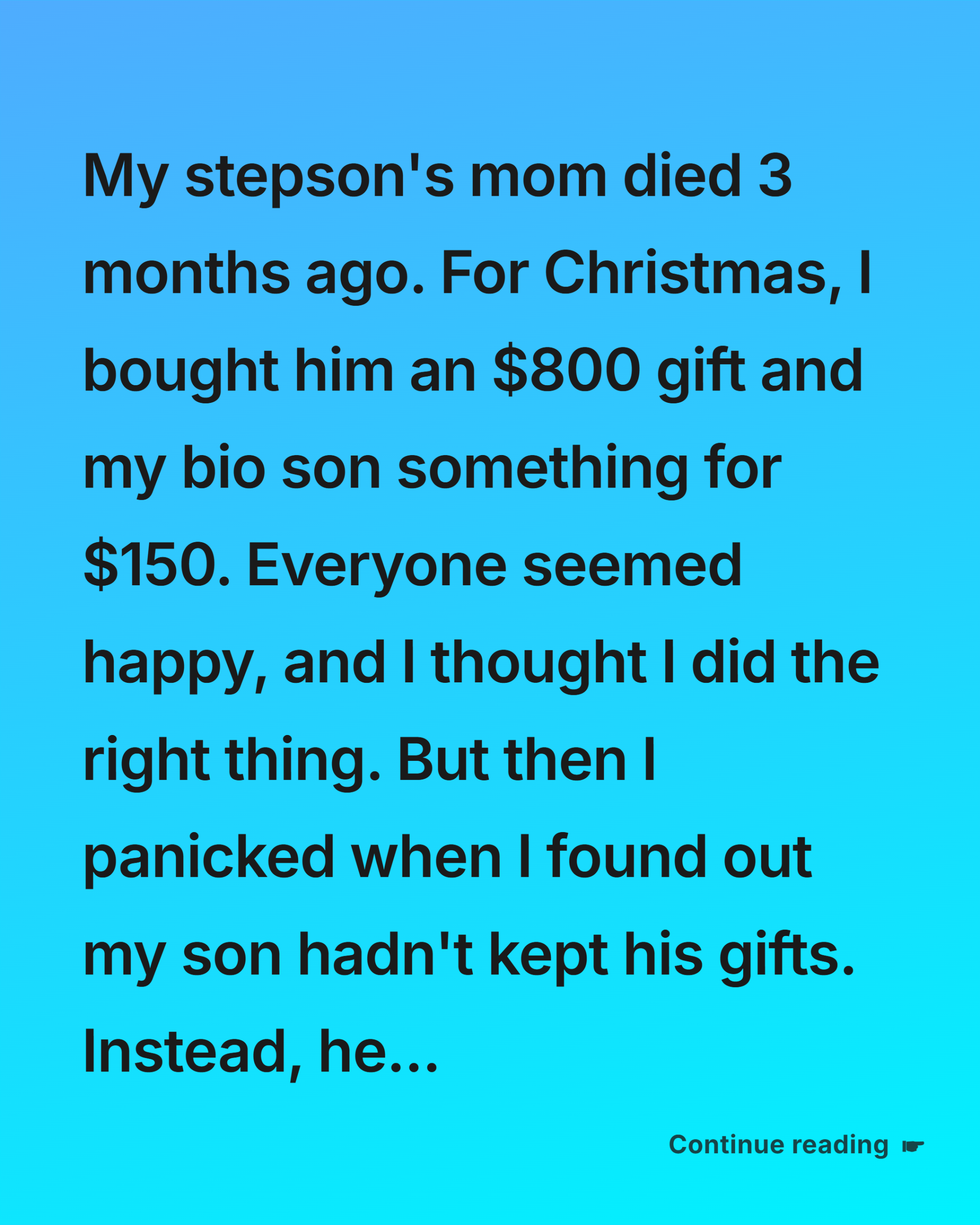
My stepson’s mom died 3 months ago. It was a sudden, devastating loss that left our household feeling like it was constantly walking on eggshells. Rowan is only fourteen, and he had always been close to his mother, despite the messy divorce years back. When she passed, he moved in with us full-time, bringing with him a mountain of grief that he kept tightly packed behind a polite, quiet exterior. I wanted so badly to reach him, to show him that he was loved and that our home was his fortress, too. But every attempt seemed to stop at an invisible wall. I would ask if he wanted dinner, and he would quietly say yes. I would ask about school, and he would shrug. Sometimes I would catch him staring at his phone late at night, scrolling through old pictures of his mother, and the moment he realized I had noticed, he would lock the screen and pretend nothing had happened. I knew he was hurting, but I had no idea how deeply.
For Christmas, I decided to go all out to try and spark even a glimmer of joy in his eyes. I bought him an $800 gift—a top-of-the-line gaming laptop he had mentioned once in passing months ago. It was a massive stretch for our budget, but I felt like I had to compensate for the hole in his life. At the same time, I bought my bio son, Toby, something for $150, which was a high-end skateboard he had been begging for. Toby is twelve, energetic, and luckily, a very understanding kid who has always been protective of his older stepbrother. I knew the difference in price might look unfair, but in my mind, I wasn’t really comparing two Christmas gifts. I was trying to give Rowan something big enough to make him forget, even for a few minutes, about the biggest loss of his life. Looking back, I realize how badly I misunderstood what he needed.
Everyone seemed happy on Christmas morning, and I thought I did the right thing. Rowan’s hands shook a little when he opened the laptop, and he gave me a genuine, whispered “thank you” that made my eyes sting. Toby was over the moon with his skateboard, immediately rushing out to the driveway to test his balance. Seeing them both smiling for the first time in months made me feel like I had finally navigated the impossible waters of a blended family in crisis. I went to bed that night feeling a profound sense of peace. For the first time since Rowan had moved in, I thought perhaps the worst was behind us. I didn’t know that while I was lying in bed congratulating myself for bringing some happiness back into the house, another kind of Christmas miracle had already begun—one that involved neither money nor anything I had purchased.
But then I panicked when I found out my son hadn’t kept his gifts. It happened a few days after New Year’s when I went into Toby’s room to grab his laundry. The skateboard was gone, which I assumed meant he’d left it at a friend’s house or in the garage. But then I noticed his older game console was missing, too, along with a few of his favorite hoodies and the brand-new sneakers I’d bought him for school. My heart started racing as I wondered if we’d been robbed or if Toby had gotten himself into some kind of trouble I didn’t know about. I checked the closets, the garage, even the trunk of my car. Nothing. The more things I realized were missing, the more frightened I became. This wasn’t a forgotten skateboard at a friend’s house. Toby had somehow gotten rid of a shocking amount of his belongings, and he had done it without telling me.
I pulled Toby aside that afternoon, my voice trembling with a mix of fear and confusion. “Toby, where is your new skateboard? And your console?” He looked at his feet, his face turning a bright shade of red that usually meant he was hiding something big. He tried to brush it off, saying he’d just misplaced things, but I knew my son better than that. I sat him down on the sofa and told him he wasn’t in trouble, but that I needed to know the truth. For several seconds, he said nothing. Then he glanced toward the hallway, almost as if he were checking whether someone was listening. That tiny movement made my stomach tighten. I suddenly wondered whether Rowan was somehow involved, whether someone had pressured Toby, or whether something much worse had happened during those quiet days after Christmas.
Instead, he looked at me with those big, honest eyes and said, “I sold them, Mom.” My jaw nearly hit the floor as I processed what he was saying. I couldn’t understand why a twelve-year-old would sell his most prized possessions right after Christmas. I asked him if he needed money for something, or if someone was bullying him into giving them things. He shook his head slowly, reached into his pocket, and pulled out a crumpled receipt from a local pawn shop and a small, velvet box. My hands went cold when I saw the box. “What’s in there?” I asked. Toby didn’t answer immediately. He just held it tightly in both hands, as though whatever was inside was more fragile than glass.
“Rowan’s mom had this necklace,” Toby whispered, his voice cracking a little. “He told me once that it was the only thing he really wanted from her house, but it got lost or sold when they were clearing things out.” I stared at the box, my breath catching in my throat as I realized what my twelve-year-old had done. He hadn’t sold his things for himself; he had sold them to track down a piece of his brother’s history that had been accidentally discarded during the chaos of the funeral. Toby explained that Rowan had mentioned the necklace only once, late one night when they were talking. It had belonged to their mother, and Rowan remembered the little details about it—the shape of the locket, the engraving, even a tiny scratch on the back. He had searched for it after the funeral, but everyone had assumed it was gone forever. Apparently, Toby had never forgotten.
Toby had spent his entire Christmas break calling local pawn shops and estate liquidators, describing a vintage locket with a specific engraving. He’d finally found it at a shop three towns over, but the price was way beyond his allowance. So, he traded in his new skateboard, his gaming console, and anything else of value he owned to bring that locket home. He hadn’t even told Rowan yet because he was afraid it wouldn’t be the right one. He had apparently called the shop several times before finally going there, terrified someone else would buy it. When the owner confirmed the engraving matched Rowan’s description, Toby emptied his savings and began selling whatever he could. “I didn’t want him to think Mom was gone forever,” he told me quietly. “I thought if I could give him something she touched, maybe he’d know she’s still part of us.” I had to turn away because I could feel tears coming.
I felt a wave of humility wash over me that made my $800 laptop feel like a cheap, thoughtless plastic toy. I had been trying to buy Rowan’s happiness with high-tech gadgets, thinking that material wealth could fill the void left by his mother. But Toby, with the simple, pure heart of a child, understood that Rowan didn’t need to escape reality into a video game. He needed a bridge back to the love he thought he had lost forever. I looked at the pawn shop receipt again and realized that Toby had sacrificed things he genuinely loved, things he had been excited to receive only days earlier, without expecting praise or even telling anyone what he had done. I suddenly felt ashamed that I had been so focused on the price tags of our Christmas gifts. My son had never cared about the price. He had cared about his brother.
We went into Rowan’s room together that evening, and Toby nervously handed him the velvet box. I watched from the doorway as Rowan opened it, and the silence that followed was the loudest thing I’ve ever heard. He picked up the gold locket, his fingers tracing the initials of his mother, and then he did something he hadn’t done since moving in. He let out a sob, a real, guttural release of all the pain he’d been holding back, and he threw his arms around Toby. At first, Rowan seemed frozen, as if his mind couldn’t understand what he was seeing. Then he whispered, “Where did you get this?” Toby simply told him the truth. Rowan stared at him for several seconds before breaking down completely. He pressed the locket against his chest and cried so hard that Toby began crying, too. I stood in the doorway with tears streaming down my face, realizing that I was witnessing something money could never have created.
It wasn’t just a gift; it was a recognition of his grief and a confirmation that he was truly seen in this house. Toby didn’t care about the skateboard or the games; he just sat there holding his brother, looking at me with a small, knowing smile. In that moment, the “bio” and “step” labels that I had been so worried about vanished completely. They weren’t two boys from different lives trying to coexist; they were brothers, bonded by a sacrifice that I hadn’t even been wise enough to suggest. Rowan kept the locket around his neck that night and refused to take it off, even when he went to sleep. Before I left the room, he quietly said, “Mom would have liked you, Toby.” Toby smiled through his tears and answered, “I think I would’ve liked her, too.” That sentence broke whatever remained of my composure.
A week later, I found a small envelope on my nightstand with my name on it. Inside was a note from Rowan and the $800 I had spent on the laptop. He had sold the laptop back to the store—barely used—and used the money plus some of his own savings to buy Toby a brand-new, even better skateboard and a replacement console. He wrote, “Gifts are cool, but Toby showed me what family actually means. I don’t need the computer as much as I need him to know he’s the best brother in the world.” I read the note twice because I couldn’t believe what I was seeing. I had been so worried about making sure the boys received equal love that I hadn’t noticed they were already giving each other something far more valuable. Rowan had also written one final sentence at the bottom: “Thank you for trying, Mom. I know now that you weren’t trying to buy me a replacement for her. You were just trying to make sure I wasn’t alone.”
I sat on my bed and cried, realizing that my children were far better people than I was. I had spent so much time worrying about the “fairness” of the dollar amounts, trying to balance the scales of a tragedy with a checkbook. But these two boys had created their own economy of kindness, one where the only currency that mattered was sacrifice and empathy. They had taught me that you can’t curate a family with a credit card; you build it by being willing to give up what you want for what someone else needs. I had thought the $800 laptop was my greatest gift to Rowan, but in the end, the greatest gift in our house had cost twelve-year-old Toby almost everything he owned. And somehow, neither boy seemed to think he had lost anything.
We spent the rest of the winter in a house that finally felt warm. The “expensive” gifts were gone, replaced by a used locket and some mid-range sports equipment, but the atmosphere was lighter than it had ever been. Rowan started talking more about his mom, sharing stories with Toby while they sat on the floor of the living room. Toby listened with rapt attention, realizing that he had given his brother the greatest gift of all—the permission to remember. Sometimes Rowan would take out the locket and tell us where his mother had worn it, what perfume she used to wear, and how she would tap the locket twice whenever she was nervous. Those little stories slowly became part of our family history instead of something hidden behind closed doors. One evening, I heard the boys laughing together upstairs, and I stopped in the hallway just to listen. It was the first time I had heard Rowan laugh like that since his mother died.
This experience changed the way I look at every relationship in my life. We often think that showing up for people means bringing the biggest, flashiest offering to the table. We think that money can solve the problems of the heart, or that we can “fix” grief if we just provide enough distractions. But true love is quiet, it’s observant, and it’s usually found in the things we are willing to let go of to make someone else feel whole. I had believed I needed to rescue Rowan from his grief, when what he really needed was someone willing to sit beside him while he carried it. Toby understood that instinctively. He didn’t try to make Rowan stop missing his mother. He simply gave him something that made remembering her hurt a little less.
I learned that the most valuable things we own aren’t the things we keep, but the things we give away when it really counts. My sons taught me that a family isn’t defined by blood or by a legal document, but by the way we carry each other’s burdens. I thought I was the one teaching them how to live, but they were the ones showing me how to love. And every time I see that little gold locket resting against Rowan’s chest, I remember the lesson. Sometimes the greatest gift isn’t the one wrapped beneath the Christmas tree. Sometimes it is the thing someone quietly gives up when nobody is watching, simply because they love you enough to notice what your heart has been missing.